
Red Light Therapy at Home in Canada: What It Does, Benefits & What to Look For
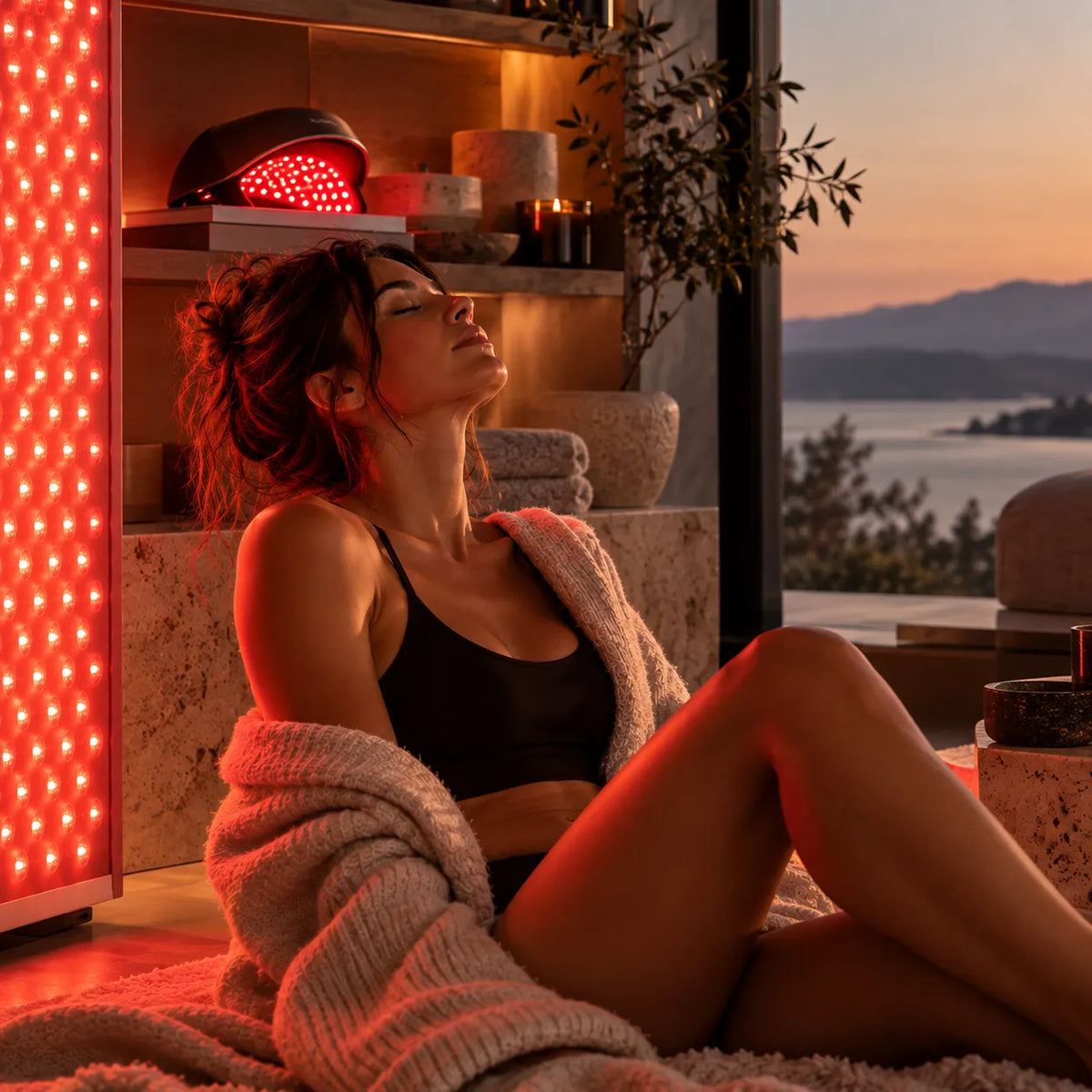
Red light has moved beyond the facial mask.
You may have first encountered red light therapy as a beauty treatment - something promising better-looking skin without needles, downtime or another serum.
But increasingly, red and near-infrared light are showing up somewhere else entirely: full-body panels, recovery spaces, wellness studios and at-home routines.
The appeal is understandable. Stand in front of a light for a few minutes. No appointment. No recovery time. Repeat. But with devices ranging from small beauty tools to powerful full-body panels and an internet full of increasingly ambitious claims, figuring out what red light therapy actually does is considerably less simple.
Here’s what’s worth knowing before bringing it home.
What is red light therapy?
Red light therapy is a form of photobiomodulation (PBM) - the use of specific wavelengths of red and near-infrared light to influence biological processes in the body. Unlike ultraviolet light, the wavelengths used in photobiomodulation aren't intended to tan or damage the skin.
Instead, research suggests that light within certain red and near-infrared ranges can interact with cells and influence cellular activity. One proposed mechanism involves the mitochondria — the structures responsible for producing much of a cell's usable energy. PubMed Central (PMC)
In considerably less scientific language?
The light isn't simply warming you. Your tissue is interacting with it. And that distinction is what makes red light therapy interesting.

Red light vs. near-infrared: they're not quite the same thing
You'll often see red light and near-infrared light (NIR) listed together. There is a reason.
Red light generally occupies wavelengths of roughly 620–700 nm, while near-infrared extends beyond the visible red spectrum. Near-infrared light can penetrate more deeply into tissue than visible red light, which is why devices designed for broader wellness and recovery applications frequently combine the two. ScienceDirect
You can see red light. Near-infrared is largely invisible to the human eye. Rather than assuming that a device with the greatest number of wavelengths must therefore be the best, pay attention to which wavelengths it uses, how the light is delivered and what the device is designed to accomplish. More isn't automatically better.
So, does red light therapy actually work?
This is where we'd rather be accurate than breathless. There is legitimate research behind photobiomodulation. There is also a lot we still don't know.
A large umbrella review covering 204 randomized clinical trials and more than 9,000 participants found beneficial effects across a number of health outcomes. But researchers rated much of the overall evidence as low to moderate certainty and emphasized the need for better standardized protocols and higher-quality trials. PubMed
That's important because red light therapy is sometimes marketed as though virtually every proposed benefit has already been conclusively established. It hasn't. What we do have is a growing and genuinely interesting body of research.
Skin
Red light is perhaps best known in beauty for its potential effects on signs of skin ageing.
The American Academy of Dermatology notes that studies of red-light LED devices have shown improvements ranging from subtle to noticeable in concerns including fine lines, wrinkles, discolouration and skin texture. It also cautions that devices and study protocols vary considerably, making direct comparisons difficult. American Academy of Dermatology
Translation: promising, yes. Magic lamp, no.
Red light is perhaps best known in beauty for its potential effects on signs of skin ageing. If your focus is specifically changing skin after 40, you can also read our guide to the best skincare for mature skin in Canada.

Hair
Photobiomodulation has also been studied for certain forms of hair loss.
The evidence here is particularly interesting: a recent umbrella review found moderate-certainty evidence supporting improvement in hair density for androgenetic alopecia. PubMed
That's also why you'll increasingly see red-light caps and helmets designed specifically for scalp use rather than general-purpose panels.
Recovery, discomfort & physical wellness
This is where red light becomes much bigger than beauty.
Photobiomodulation has been investigated across pain, inflammation, tissue repair and a range of musculoskeletal and medical applications. Results differ substantially depending upon the condition and treatment protocol, and evidence is stronger for some applications than others. PubMed
That doesn't mean a home panel should be treated as medical treatment. It does explain why red and near-infrared light have increasingly found their way into recovery and wellness routines.
What should you look for in an at-home red light therapy device?
This is where shopping gets unnecessarily confusing.
Manufacturers can give you an impressive-looking list of LEDs, wattage figures and wavelengths without telling you much about how useful the device will actually be for you.
Start here.
1. Wavelengths
Look for the actual wavelengths - measured in nanometres (nm) - rather than simply the words “red light.”
For a wellness or full-body device, you'll commonly find a combination of visible red and near-infrared wavelengths.
2. Irradiance
Irradiance describes the amount of light power reaching a given area, usually expressed in mW/cm². Higher isn't automatically superior.
Dose is affected by irradiance and time, which means an extremely powerful device isn't necessarily more effective simply because its specification sheet contains a bigger number. Research protocols vary considerably, and optimal dosing depends on the application. PubMed Central (PMC)
3. Treatment area matters
This one is wonderfully uncomplicated. A facial LED mask makes sense when your primary goal is facial skin. Larger red light devices can offer broader coverage for those interested in incorporating light into a wider wellness or recovery routine. The right format depends less on which device looks most impressive and more on what you actually want to use it for.

Coverage matters because the device you consistently use will generally be more useful than the technically impressive one that turns your routine into a logistical exercise.
4. Distance and treatment time
Don't assume you need to stand as close as physically possible to a panel.
The manufacturer's recommended distance, treatment time and frequency matter because they influence the dose of light reaching your body.
Follow the protocol designed for the particular device rather than borrowing somebody else's routine from TikTok.
5. The company behind it
This may be the least exciting specification and one of the most important.
A red light device can be a significant investment.
Look at the warranty, technical specifications, support, safety information and transparency behind the product, not simply its number of LEDs.
How often should you use red light therapy?
There isn't one universal schedule. Different devices deliver different intensities and are designed for different treatment distances and durations.
What does appear consistently across at-home photobiomodulation is that regular use matters. The American Academy of Dermatology notes that at-home red light isn't a one-and-done treatment and recommends following the directions provided with the individual device. American Academy of Dermatology
So resist the temptation to create your own heroic 45-minute protocol. More isn't necessarily more.
Consistency beats intensity.
Is red light therapy safe?
Red light therapy is generally considered non-invasive and short-term use appears to have a favourable safety profile. Unlike ultraviolet radiation, red light isn't associated with the same UV-induced skin damage. American Academy of Dermatology
That doesn't make every device appropriate for every person. Follow the manufacturer's instructions regarding eye protection. And if you have a medical condition, a photosensitivity disorder, take medications that increase light sensitivity, are receiving medical treatment, or are unsure whether photobiomodulation is appropriate for you, speak with a qualified healthcare professional before using it. American Academy of Dermatology

Is at-home red light therapy worth it?
Potentially, but we'd look at it differently than most beauty purchases. You're not buying a treatment. You're buying access to one.
A home device makes the most sense for someone who intends to make red light a regular part of their routine. The convenience of walking into another room and using it consistently is arguably the entire point.
If you're mildly curious and realistically going to use it three times before forgetting it exists, book a professional session first.
If you already use red light regularly, are interested in long-term skin or scalp care, or want to incorporate light into a broader recovery and wellness routine, bringing the technology home becomes considerably easier to justify.
The Smukke perspective
We like technology. We don't particularly like technology dressed up as magic.
Red light therapy sits in an interesting place between beauty, recovery and longevity backed by legitimate science, while still surrounded by claims that sometimes run considerably ahead of it.
Our approach is therefore simple: Look at the evidence. Look at the device. Ignore the hype. Then decide whether it deserves a place in your life.
Explore Smukke House's edit of at-home red and near-infrared light technology.
A note before you begin
This article is for general educational purposes and isn't medical advice. Red light and near-infrared devices aren't intended to diagnose, treat, cure or prevent disease unless specifically authorized for that purpose by the applicable regulator. Individual results vary. Always follow the instructions and safety information supplied with your device and consult a qualified healthcare professional if you have questions about whether light therapy is appropriate for you.


Comments